
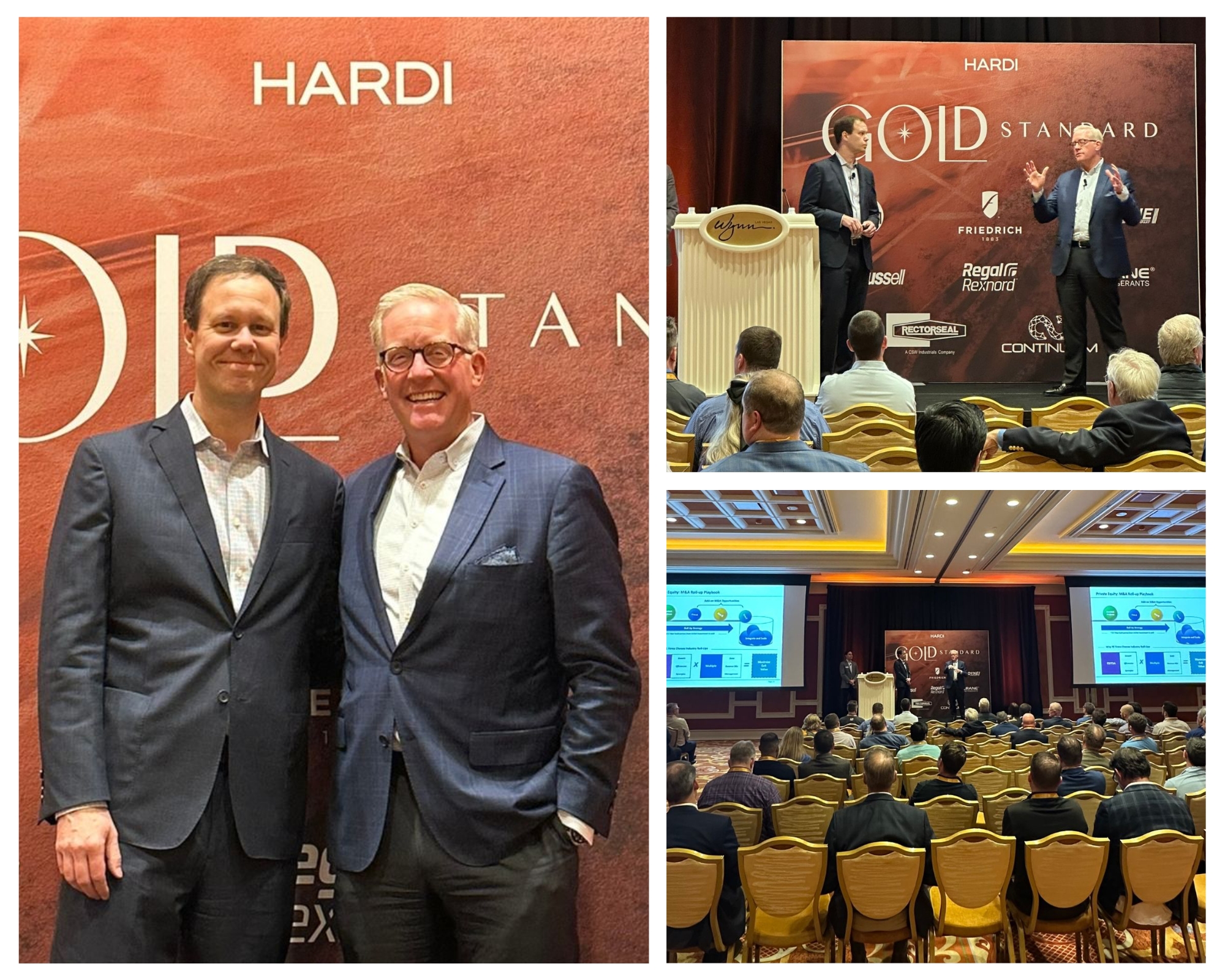
The HARDI HVAC distribution base and broader HARDI member community gathered last week in Las Vegas for the 2025 Annual Conference, an event that once again underscored both the scale and momentum of the HVACR industry.
HARDI welcomed more than 2,000 attendees to this year’s conference, including 180 distributor companies and over 600 total member organizations. Attendance reached another record high, reinforcing HARDI’s position as the central convening point for HVAC distribution leadership and highlighting the industry’s continued resilience and long-term opportunity. We at Carter Morse & Goodrich (CMG) were proud to participate as HARDI members and subject matter speakers, with the firm’s HVAC lead Chris Reenock and Managing Partner Ramsey Goodrich presenting the M&A outlook at this year’s event.
Over four days, the conference agenda spanned a wide range of timely topics, including the macroeconomic outlook, supply chain dynamics, regulatory developments, distributor–contractor relationships, talent and leadership challenges, and importantly, business succession planning and M&A considerations.
Below are CMG’s key takeaways from the conference, informed both by formal sessions and dozens of conversations with distributor executives, OEM partners, and financial sponsors.
CMG’s Key Takeaways
- M&A Activity: Momentum Where It Matters
CMG was honored to be invited by HARDI to lead the M&A Outlook session at this year’s conference. While overall U.S. deal volumes have not rebounded as sharply as many expected entering 2025, add-on acquisition activity remains strong, particularly within HVAC and related services.
This is most evident among super-regional and national consolidators, many of which continue to pursue disciplined growth strategies supported by private equity capital. In distribution specifically, buyers remain highly focused on:
- Geographic density
- Share-of-wallet expansion
- Complementary product lines (controls, parts, adjacent trades)
- Strong management teams and scalable platforms
In short, while headline deal volume may be uneven, strategic M&A remains a powerful value-creation tool for the right businesses, with signs pointing to increased momentum for platform acquisitions, as well as continued strong add-on activity, in 2026.
- CMG Channel Checks with HARDI Distributors – How to Handle Dealer M&A Consolidation
One topic of interest this year for distributors was the ongoing consolidation of the HVACR dealer base, particularly from private equity-backed platforms. Ahead of our M&A panel presentation, CMG carried out conversations with a representative cross-section of HARDI distributor members to hear how they are handling the M&A consolidation phenomenon in their own businesses. Those conversations revealed consistent themes among winning distributors who continue to outperform, including:
Focus relentlessly on what you do best – service
Winning distributors are doubling down on fundamentals that truly matter to contractors:
- On-time, job-site delivery
- After-hours and emergency support
- Inventory availability and reliability
- Seamless digital ordering and user experience
- Comprehensive dealer and technician training
Make sales relationships truly win-win
While OEM pricing structures and preferred programs matter, the most effective distributors approach contractor relationships with pragmatism. Equipment economics must work—but so must parts, supplies, accessories, and ongoing service support. The strongest partnerships are built with transparency and long-term alignment.
Be willing to think creatively
Several distributors highlighted innovative approaches to growing wallet share with existing customers or securing new relationships. One example we heard repeatedly: creative rebate or incentive structures tied directly to private equity-backed contractor platforms, helping lock in parts and supplies business alongside equipment sales.
- Lessons from Private Equity: Strategic Growth Still Wins
One clear takeaway from both formal sessions and private discussions is that consolidation – when executed with discipline – has driven meaningful value creation across HVAC markets.
Distributors can borrow selectively from the private equity playbook by asking:
- Is there a small distributor that meaningfully strengthens our geographic footprint?
- Are there adjacent categories where we are under-penetrated with existing customers?
- How can we increase share of wallet without diluting service quality?
Controls, HVAC parts, and plumbing fixtures/appliances were frequently cited as product categories most likely to be sourced outside a distributor’s primary supplier today, representing tangible growth opportunities.
- Succession Planning For Business Owners in HVAC: Still the Exception, Not the Rule
HARDI’s Voice of the Contractor study reinforced a persistent challenge across the industry: lack of formal succession planning.
As of 2024: ~60% of small HVAC contractors and ~40% of larger contractors do not have a formal succession plan in place.
While this data focuses on the contractor base, it reflects a broader reality across family-owned and founder-led businesses at large, whether in HVAC or otherwise. Without a thoughtful succession strategy, family and founder business owners risk being forced into suboptimal decisions when transition timing becomes unavoidable. Early planning creates optionality – whether through internal succession, partial liquidity, or a full strategic sale – especially as transition activity accelerates and M&A demand across the industry remains strong.
- HVAC Market Outlook: Resilient, with Tailwinds Ahead
HARDI’s market update painted a picture of measured but resilient performance, with overall sales growth of ~3.5% in 2025, despite headwinds like persistently high interest rates, the A2L refrigerant transition and tariff uncertainty.
- Non-residential activity drove industry upside this year, with strength in both light commercial and applied end markets
- In residential, there was slower (but positive) growth driven by continued stability in repair and maintenance, reflecting the mission-critical nature of HVAC equipment
Looking ahead to 2026, anticipated interest rate reductions could support an improving foundation for:
- Increased residential transaction activity
- Improved commercial project pipelines
- A more favorable environment for both organic growth and strategic investment
Closing Thoughts
HARDI’s 2025 Annual Conference reinforced a central theme: the HVAC distribution industry remains fundamentally strong, and the strategies employed by leading distributors offer a clear roadmap for others to win as well. Distributors that invest in service excellence, strategic growth, leadership continuity, and long-term planning are best positioned to thrive – whether independently or as part of a larger platform.
CMG appreciated the opportunity to engage with HARDI members throughout the conference and looks forward to continuing the dialogue with distributor leaders navigating the next phase of growth and transition.
As always, if you would like to discuss your business and our outlook on the HVAC markets, we are always happy to connect and talk further. Please reach out directly to our team.